
Table of Contents
Origin of Cricket
History of cricket started in England and has grown into one of the most popular sports in the world. This history of cricket explains how the game evolved from village cricket to international formats like Test, ODI, T20, and T10. Cricket started in England during the 16th century, mainly in rural areas. In the early days, it was not a professional sport. Children used to play it in villages using simple tools like a wooden stick and a ball made from basic materials. There were no proper rules, no fixed teams, and no official grounds.
As time passed, adults also began playing the game. By the 17th century, cricket became popular among local communities. People started organizing matches between villages, and small competitions began to take place. This was the stage when cricket started moving from a casual game to a more structured activity.
One important change came in the 18th century, when cricket began to attract attention from the upper class in England. With more interest and money involved, the need for proper rules became important. This led to the formation of the Marylebone Cricket Club in 1787. The MCC created the official laws of cricket, which are still followed today with some updates.
During this time, cricket grounds also became more organized. Lord’s Cricket Ground in London became one of the most important venues in cricket history. It is still known as the “Home of Cricket.”
Another key part of cricket’s origin is how it spread beyond England. During the period of the British Empire, the game was introduced to countries like India, Australia, and South Africa. British soldiers and officials played cricket in these regions, and slowly local people also started playing it.
The first major international step came in 1877, when England played Australia in the first-ever Test match. This marked the beginning of international cricket and showed how far the game had come from its village roots.
Today, cricket is played all over the world in different formats. But its origin remains connected to those early days in England, where it started as a simple village game and slowly grew into a global sport.
Early Development of the Game
After cricket started in English villages, the game slowly began to change. In the beginning, there were no fixed rules, and every place had its own way of playing. The number of players, the size of the ground, and even the equipment could be different from one match to another.
By the 17th century, cricket started becoming more organized. People began to play regular matches, and local teams were formed. Villages would compete with each other, and these matches started attracting small crowds. This was the time when cricket moved from a children’s game to a popular activity among adults.
As the game grew, players started improving their skills. Bowling became more controlled, batting techniques improved, and fielding also became more important. The shape of the bat changed over time, making it easier to play different shots. Earlier, bats were curved like hockey sticks, but later they became straight, which is the design we see today.
Another important change during this period was the introduction of basic rules. Even though the rules were not officially written at first, players started following common practices to make the game fair. This helped in reducing confusion during matches.
By the 18th century, cricket had become a well-known sport in England. It was no longer limited to villages. Matches were played in towns and cities, and people from different backgrounds started taking interest in the game.
This early development phase played a big role in shaping modern cricket. It created the base for proper rules, organized teams, and competitive matches. Without this stage, cricket would not have grown into the structured sport we see today.
Formation of Rules and MCC
As cricket became more popular in England, there was a clear need for proper rules. In the early days, every match was played differently, which often created confusion. To make the game fair and consistent, official rules were needed.
This led to the formation of the Marylebone Cricket Club in 1787. The MCC played a major role in shaping modern cricket. It created the first official laws of the game, which helped standardize how cricket was played.
These rules covered important aspects like the size of the pitch, number of players, method of scoring runs, and ways a batsman can get out. Over time, these laws were updated, but the basic structure created by MCC is still followed today.
Along with rules, cricket grounds also became more organized. Lord’s Cricket Ground in London became the main center of cricket activities. It is still known as the “Home of Cricket” and holds great historical importance.
The introduction of official rules made cricket more professional. It allowed teams from different regions to compete under the same conditions. This step was very important in the growth of cricket from a local game to an international sport.
Today, even though cricket has evolved with new formats and technology, the foundation laid by the MCC remains an important part of the game.
First International Cricket Match
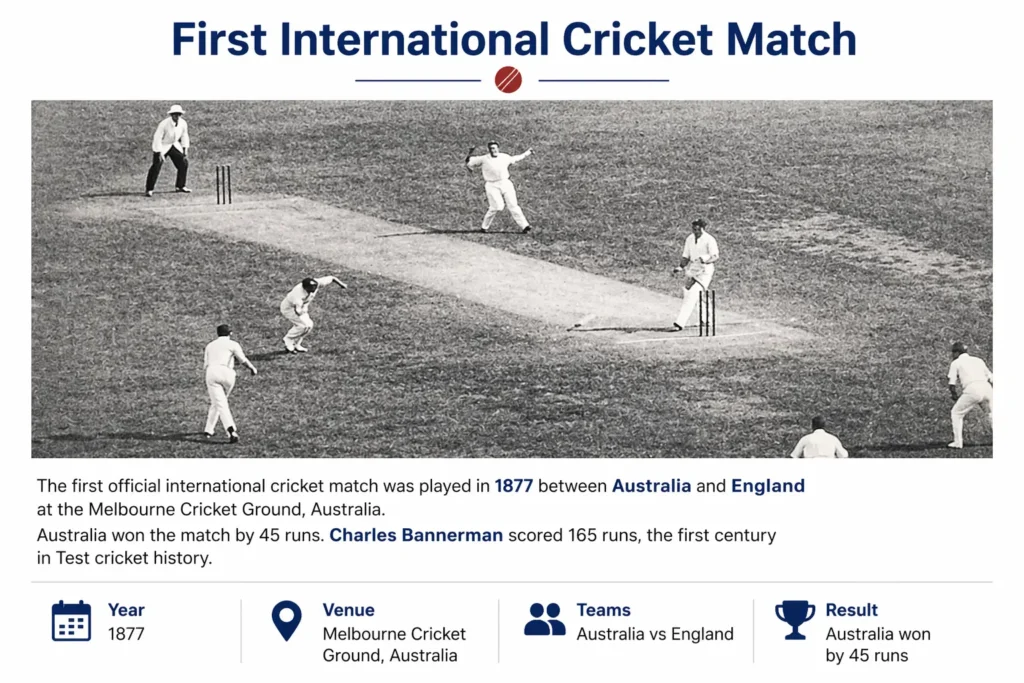
The first official Test match in cricket history was played in 1877 between England and Australia. The match took place at the Melbourne Cricket Ground (MCG) from March 15 to March 19.
This match marked the beginning of international cricket. Before this, cricket was mostly played within countries, but this game showed that teams from different nations could compete at a higher level.
Australia won the match by 45 runs, making history as the first team to win a Test match.
Growth of Test Cricket
Test cricket became the main format of the game after the first international match in 1877. It is played over five days and is often called the purest form of cricket because it tests a player’s skill, patience, and consistency.
In the early years, only a few teams like England and Australia played Test matches. Over time, more countries joined, and the format became the backbone of international cricket.
Test cricket helped build strong rivalries, especially famous series like The Ashes. It also gave players the chance to show their technique and mental strength over a long period of time. Even today, many cricket fans consider Test matches the most respected format.
As cricket expanded globally, more nations received Test status, making the format truly international.
One Day Cricket World Cups So Far
The ODI World Cup is one of the biggest tournaments in cricket. It started in 1975 and is organized by the International Cricket Council. Over the years, it has produced many memorable matches and legendary players.
The tournament is usually played every four years and features top cricketing nations from around the world.
Introduction of One Day Cricket
One Day Internationals were introduced to make cricket shorter and more result-oriented. Test matches were long, and not every fan could follow a five-day game. ODI cricket solved this by limiting the number of overs, making the match finish in a single day.
The first official ODI match was played in 1971 between Australia and England at the Melbourne Cricket Ground. This match was actually played after a Test match was abandoned due to rain. To keep the crowd engaged, a 40-over game was arranged, and that became the first ODI in history.
ODI cricket quickly became popular because it was faster and more exciting. This format later led to the first Cricket World Cup in 1975.
One Day Cricket World Cups So Far
The ODI World Cup is one of the biggest tournaments in cricket. It started in 1975 and is organized by the International Cricket Council. Over the years, it has produced many memorable matches and legendary players.
The tournament is usually played every four years and features top cricketing nations from around the world.
| Year | Winner | Runner-up | Host Country | Final Result |
|---|---|---|---|---|
| 1975 | West Indies | Australia | England | WI won by 17 runs |
| 1979 | West Indies | England | England | WI won by 92 runs |
| 1983 | India | West Indies | England | India won by 43 runs |
| 1987 | Australia | England | India/Pakistan | Australia won by 7 runs |
| 1992 | Pakistan | England | Australia/NZ | Pakistan won by 22 runs |
| 1996 | Sri Lanka | Australia | India/SL/Pak | SL won by 7 wickets |
| 1999 | Australia | Pakistan | England | Australia won by 8 wickets |
| 2003 | Australia | India | SA/Zim/Kenya | Australia won by 125 runs |
| 2007 | Australia | Sri Lanka | West Indies | Australia won by 53 runs |
| 2011 | India | Sri Lanka | India/SL/Bangladesh | India won by 6 wickets |
| 2015 | Australia | New Zealand | Australia/NZ | Australia won by 7 wickets |
| 2019 | England | New Zealand | England | Match tied (England won on boundary count) |
| 2023 | Australia | India | India | Australia won by 6 wickets |
T20 Cricket and Modern Era
T20 cricket started in 2003 and quickly changed how the game is played and watched. Unlike Test and ODI formats, T20 matches are short and finish in around three hours. This made cricket more suitable for modern audiences who prefer fast and entertaining matches.
The format focuses on aggressive batting, quick scoring, and high-energy gameplay. Because of this, new fans started watching cricket, especially younger audiences.
One of the biggest reasons for the growth of T20 cricket is the Indian Premier League. It brought players from different countries together and turned cricket into a mix of sport and entertainment. Stadiums became more lively, and players became global stars.
| Year | Winner | Runner-up | Host | Final Result |
|---|---|---|---|---|
| 2007 | India | Pakistan | South Africa | India won by 5 runs |
| 2009 | Pakistan | Sri Lanka | England | Pakistan won by 8 wickets |
| 2010 | England | Australia | West Indies | England won by 7 wickets |
| 2012 | West Indies | Sri Lanka | Sri Lanka | WI won by 36 runs |
| 2014 | Sri Lanka | India | Bangladesh | SL won by 6 wickets |
| 2016 | West Indies | England | India | WI won by 4 wickets |
| 2021 | Australia | New Zealand | UAE/Oman | Australia won by 8 wickets |
| 2022 | England | Pakistan | Australia | England won by 5 wickets |
| 2024 | India | South Africa | West Indies/USA | India won by 7 runs |
| 2026 | India | New Zealand | India | India won by 96 runs |
Role of ICC in Cricket
The International Cricket Council is the main body that manages international cricket. It is responsible for organizing major tournaments like the ODI World Cup, T20 World Cup, and Test Championship.
ICC also sets the rules of the game, maintains team rankings, and ensures fair play across all formats. It works with cricket boards of different countries to grow the sport globally and bring new teams into international cricket.
From managing umpires to introducing technology like DRS, ICC plays a big role in making cricket more professional and consistent across the world.
| Name | Country | Tenure |
|---|---|---|
| Colin Cowdrey | England | 1989–1993 |
| Clyde Walcott | West Indies | 1993–1997 |
| Jagmohan Dalmiya | India | 1997–2000 |
| Malcolm Gray | Australia | 2000–2003 |
| Ehsan Mani | Pakistan | 2003–2006 |
| Ray Mali | South Africa | 2006–2007 |
| David Morgan | England | 2007–2008 |
| Sharad Pawar | India | 2010–2012 |
| Alan Isaac | New Zealand | 2012–2014 |
| N. Srinivasan | India | 2014–2015 |
| Shashank Manohar | India | 2015–2020 |
| Greg Barclay | New Zealand | 2020–2025 |
| Jay Shah | India | 2025-Present |
Cricket in India
Cricket is extremely popular in India. For many people, it is not just a sport but a big part of daily life. From watching matches with friends to playing in local grounds, cricket is everywhere.
The success of the Indian national team and leagues like the Indian Premier League has made the game even bigger. Players have become stars, and young cricketers now dream of playing at the highest level.
But behind international success, domestic cricket plays a very important role. It is where players develop their skills and get noticed.
| Tournament | Format | Level | Details |
|---|---|---|---|
| Ranji Trophy | First-Class | State Teams | Main red-ball tournament in India |
| Vijay Hazare Trophy | List A (ODI) | State Teams | 50-over domestic competition |
| Syed Mushtaq Ali Trophy | T20 | State Teams | Top domestic T20 tournament |
| Duleep Trophy | First-Class | Zonal Teams | Inter-zonal competition |
| Irani Cup | First-Class | Champion vs Rest | Ranji winner vs Rest of India |
| Deodhar Trophy | List A | Zonal Teams | One-day format competition |
ICC Cricket World Cup
Every four years, the biggest teams in cricket come together to compete for the World Cup. Organized by the International Cricket Council, this tournament is played in the ODI format and has been running since 1975.
Over time, it has produced some of the most memorable moments in cricket history. From unexpected wins to dominant performances, the World Cup always brings high pressure matches. For any cricketer, winning this trophy is one of the biggest achievements.
ICC T20 World Cup
Short matches, fast scoring, and constant action define the T20 World Cup. Since it started in 2007, this format has brought a new audience to cricket.
The game moves quickly, and every over matters. Even smaller teams get a chance to challenge strong sides, which makes the tournament exciting. This format has played a big role in increasing the global reach of cricket.
Indian Premier League IPL
The Indian Premier League changed the way cricket is seen and played. Since 2008, it has become one of the most popular leagues in the world.
Top players from different countries play together in franchise teams. Young Indian players also get a platform to show their talent. The league is known for close matches, big scores, and strong fan support.
| Team | City |
|---|---|
| Mumbai Indians | Mumbai |
| Chennai Super Kings | Chennai |
| Royal Challengers Bangalore | Bangalore |
| Kolkata Knight Riders | Kolkata |
| Delhi Capitals | Delhi |
| Punjab Kings | Punjab |
| Rajasthan Royals | Rajasthan |
| Sunrisers Hyderabad | Hyderabad |
| Lucknow Super Giants | Lucknow |
| Gujarat Titans | Gujarat |
| Year | Winner | Runner-up |
|---|---|---|
| 2008 | Rajasthan Royals | Chennai Super Kings |
| 2009 | Deccan Chargers | Royal Challengers Bangalore |
| 2010 | Chennai Super Kings | Mumbai Indians |
| 2011 | Chennai Super Kings | Royal Challengers Bangalore |
| 2012 | Kolkata Knight Riders | Chennai Super Kings |
| 2013 | Mumbai Indians | Chennai Super Kings |
| 2014 | Kolkata Knight Riders | Punjab Kings |
| 2015 | Mumbai Indians | Chennai Super Kings |
| 2016 | Sunrisers Hyderabad | Royal Challengers Bangalore |
| 2017 | Mumbai Indians | Rising Pune Supergiant |
| 2018 | Chennai Super Kings | Sunrisers Hyderabad |
| 2019 | Mumbai Indians | Chennai Super Kings |
| 2020 | Mumbai Indians | Delhi Capitals |
| 2021 | Chennai Super Kings | Kolkata Knight Riders |
| 2022 | Gujarat Titans | Rajasthan Royals |
| 2023 | Chennai Super Kings | Gujarat Titans |
| 2024 | Kolkata Knight Riders | Sunrisers Hyderabad |
The Ashes Series
When England and Australia play against each other in the Ashes, it is more than just a series. It is one of the oldest rivalries in cricket, starting from 1882.
The matches are played in the Test format and are known for intense competition. Every series carries history and pride, which makes it special for both players and fans.
These tournaments attract millions of viewers from around the world.
Evolution of Cricket Equipment
Cricket equipment has changed a lot over time. Bats are now stronger and lighter. Protective gear like helmets and pads has improved player safety.
Technology in Cricket
Cricket today is very different from how it was played earlier. Decisions that once depended only on umpires are now supported by advanced technology, making the game more accurate and fair.
One of the biggest changes came with the introduction of the Decision Review System, commonly known as DRS. It allows players to challenge on-field decisions. Using tools like ball tracking and edge detection, umpires can review close calls and make better judgments.
Another important technology is Hawk Eye. It tracks the path of the ball and predicts its movement after pitching. This is especially useful in LBW decisions, where even a small error can change the outcome of a match.
UltraEdge, also known as Snickometer, helps detect whether the ball has touched the bat or not. It uses sound waves and visuals to confirm edges, which is very useful in caught-behind decisions.
Apart from these, slow-motion replays and high-speed cameras are also widely used. They help umpires check run-outs, stumpings, and boundary decisions with better clarity.
Technology has not only improved decision-making but has also increased trust in the game. Players, teams, and fans now feel more confident that matches are decided fairly.
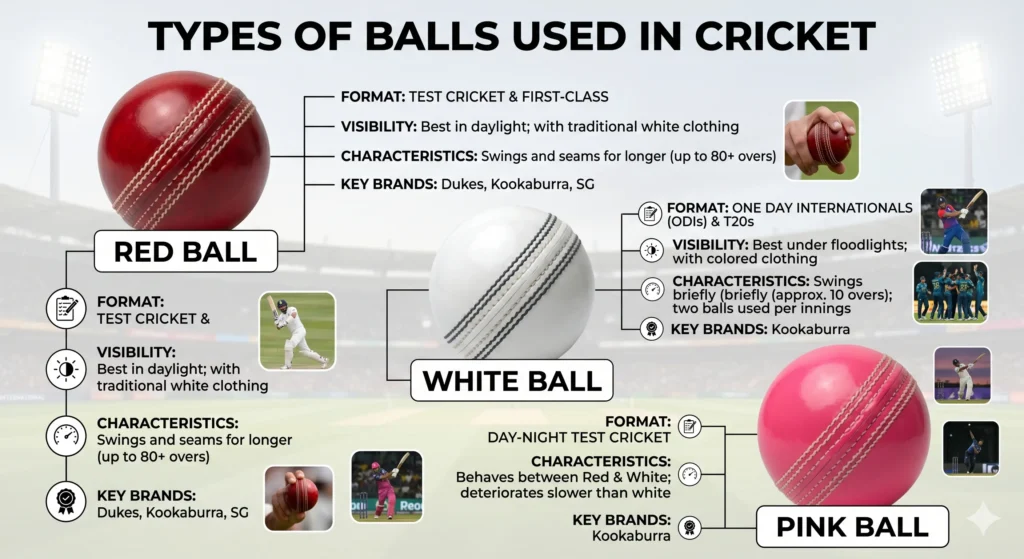
Types of Balls Used in Cricket
Cricket might look simple, but even the ball changes depending on the format and conditions. Different types of balls are used in different matches, and each one behaves differently.
Why Cricket Became Popular
Cricket did not become popular overnight. It grew step by step by adapting to what fans wanted to watch. From long Test matches to fast T20 games, the sport has changed with time, and that is one of the biggest reasons behind its global success.
Different formats have played a big role in this growth. Test cricket attracts fans who enjoy strategy and patience, while shorter formats like ODIs and T20 matches bring quick results and excitement. This variety makes cricket interesting for all types of audiences.
Another reason is the rise of big tournaments. Events organized by the International Cricket Council, along with leagues like the Indian Premier League, have brought massive attention to the game. These tournaments create high-pressure matches that fans love to watch.
Rivalries have also added to the popularity. Matches between top teams create strong emotions and excitement among fans. Whether it is historic rivalries or modern-day competitions, these games attract huge viewership.
Media and technology have made cricket more accessible. Live streaming, highlights, and social media keep fans connected with the game at all times. People can now follow matches from anywhere, which has increased the reach of cricket.
In the end, cricket keeps growing because it keeps changing. It balances tradition with modern style, which is why it continues to attract new fans while keeping old ones engaged.
T10 Cricket
Cricket didn’t stop evolving with T20. A newer and even faster format called T10 cricket has taken things to another level. In this format, each team gets just 10 overs, which means the entire match finishes in around 90 minutes.
The idea behind T10 is simple. Make the game quick, exciting, and easy to watch for people who don’t have time for longer matches. Every ball matters, and players focus on aggressive batting from the very start. There is very little room for slow play, which keeps the action constant.
Leagues like the Abu Dhabi T10 League have helped this format grow. International players participate, and matches are played in a fast-paced environment with back-to-back games.
T10 cricket is still new compared to other formats, but it is gaining attention quickly. It appeals especially to younger audiences and viewers who prefer short and entertaining sports content.
Even though it is shorter, the basic rules of cricket remain the same. This balance between tradition and speed is what makes T10 an interesting addition to modern cricket.
What is the origin of cricket?
Cricket started in England during the 16th century as a simple village game and later developed into an international sport.
Who controls international cricket?
International cricket is managed by the International Cricket Council, which organizes major tournaments and sets rules.
What are the main formats of cricket?
The three main formats are Test cricket, One Day Internationals, and T20 cricket. T10 is a newer and faster format.
Which is the biggest cricket tournament in the world?
The ICC Cricket World Cup is considered the biggest and most prestigious tournament in cricket.
Why is cricket so popular in India?
Cricket is popular in India because of strong fan support, successful players, and leagues like the Indian Premier League.
What is DRS in cricket?
DRS, or Decision Review System, is a technology used to review umpire decisions using tools like ball tracking and UltraEdge.
What is the difference between T20 and T10 cricket?
T20 matches have 20 overs per side, while T10 matches have only 10 overs, making them shorter and faster.
Which country won the first Cricket World Cup?
West Indies won the first ICC Cricket World Cup in 1975.